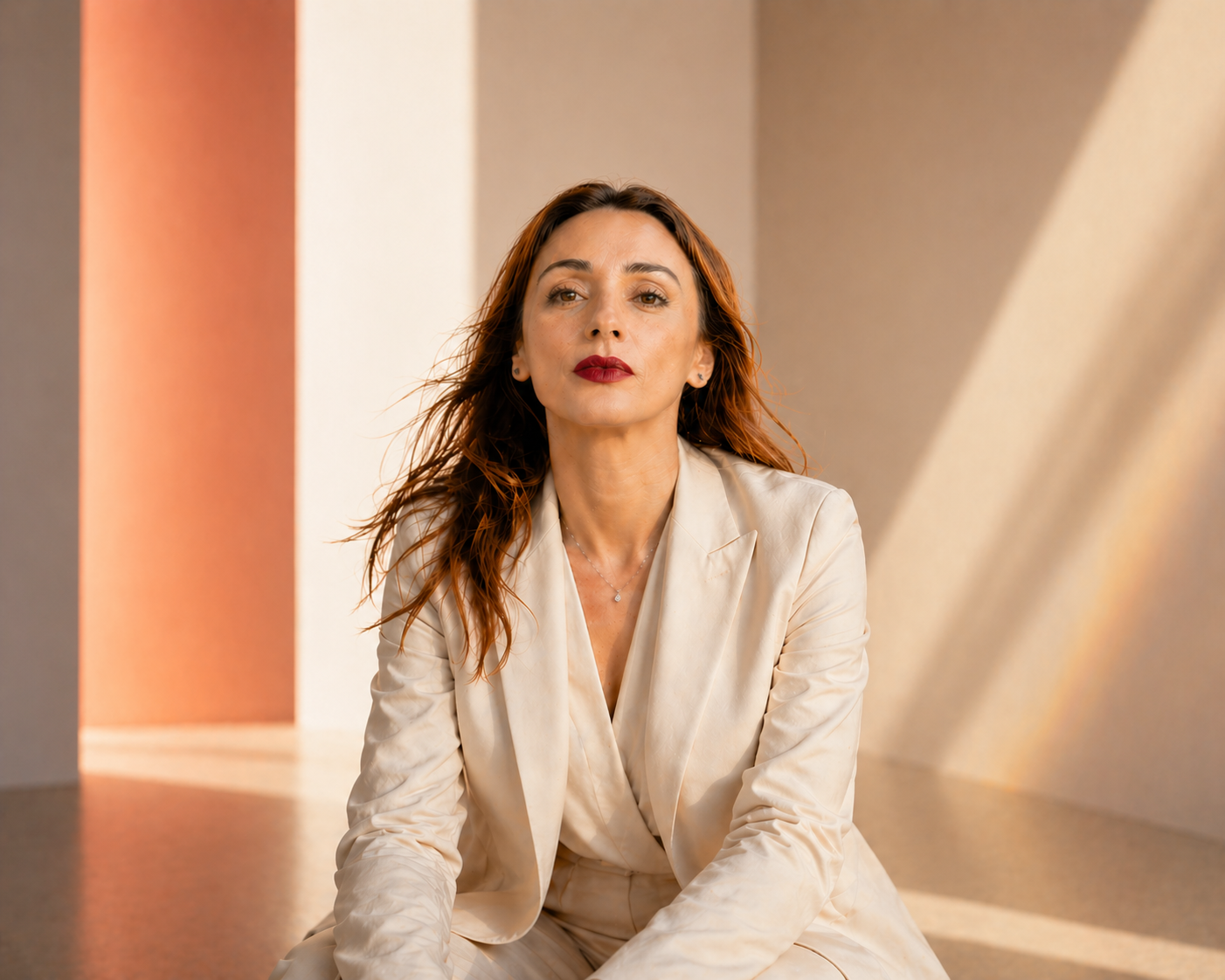
Cultural strategist working at the intersection of art, policy, and international systems.
A multilingual expert in international relations, arts and culture, diplomacy, and social impact, Aida Balamaci has built a practice at the meeting points of policy and creative life — convening governments, institutions, artists, and grassroots communities around shared cultural questions.
Her career began at the United Nations in Brussels and continued at the UN headquarters in New York, where she specialised in migration, partnerships, and gender equality. She later moved into cultural diplomacy as Cultural and Community Attaché for the Austrian Consulate General in New York, and then as Head of Visual Arts, Architecture & Design at the Austrian Cultural Forum in the same city.
Today, through PrismART Strategies, Aida works with institutions, foundations, and cultural actors to translate cultural intelligence into strategic direction — building partnerships, frameworks, and initiatives that move across borders.
Aida's path into international relations was shaped early — by a personal story of migration from communist Romania to Austria as a child, and by her studies in political science and international development. She wanted to be part of communities working to improve people's lives across the globe, and the United Nations offered the most direct route.
As a Communities and Partnerships Specialist for the UN, she worked across Brussels and New York on multi-stakeholder initiatives — bringing together government officials, academics, NGO workers, and private sector partners around shared development goals. Two of the pioneering projects she shaped, the Joint Migration and Development Initiative and the International Knowledge Network of Women in Politics, became models for how diplomacy and grassroots advocacy could move in the same direction.
That early period reinforced a conviction that runs through her practice today: international policy only matters when it connects with the real needs of people on the ground.
At UN Women, Aida served as community manager for iKNOW Politics — a joint initiative of International IDEA, the Inter-Parliamentary Union, UNDP, and UN Women, dedicated to increasing the participation and effectiveness of women in political life.
The platform connected women in politics and aspiring politicians across the globe — sharing experience, mentorship, and resources, and building the networks of support that have helped many women run for office in fields traditionally closed to them.
It was during this period that Aida met Madeleine Albright, whose journey from refugee to first female U.S. Secretary of State remains one of the most influential moments of her career — a reminder that beginnings do not define potential.
Aida's move into cultural diplomacy began at the Austrian Consulate General in New York, where she saw firsthand how culture shapes the texture of international relations. At the Austrian Cultural Forum, as Head of Visual Arts, Architecture & Design, she developed programmes that used contemporary art as a language for mutual understanding between nations.
Increasingly, her work has expanded to include collaborations with the Romanian Cultural Institute and other partners — promoting the cultural heritage of Austria, where she grew up, and Romania, where she was born, while engaging with New York's wider cultural ecosystem.
That vision sits at the centre of PrismART Strategies: using the arts as a bridge to connect diverse cultures, foster dialogue, and build more empathetic global communities.
Alongside her strategic and institutional work, Aida has developed a curatorial practice that uses exhibitions as instruments of cultural inquiry. Goddesses, Amazons, and Mothers — A Celebration of Female Creativity, presented at the Romanian Cultural Institute, gathered artists from across cultures to explore the archetypes of the feminine and the histories they carry.
Her curatorial projects share a consistent logic: each exhibition is a frame for a larger conversation, designed to travel between institutions and audiences rather than sit in a single moment.
Five languages. Seven countries lived in. Decades of travel. Aida brings to her work a worldview shaped by movement — by the experience of crossing thresholds and translating between contexts, which she sees as a defining condition of cultural practice today.
Her method draws on three threads: collaboration, the conviction that the strongest cultural work is built across disciplines; connectivity, the work of weaving relationships between actors who would otherwise not meet; and reciprocity, the principle that exchange must move in both directions to be meaningful.
Looking forward, Aida is focused on designing sustainable cultural development projects with lasting impact — large-scale international exchange programmes that bring together artists, thinkers, and communities, and the cultural infrastructure needed to support them.
Her vision is for cultural work that operates at the scale of systems rather than single events: hubs of creativity and understanding where people from across the world come together to learn, create, and contribute to a shared cultural commons.
Working across disciplines, sectors, and borders. The strongest cultural strategy is built when policy thinkers, institutions, artists, and communities sit at the same table.
Weaving relationships between actors who would otherwise not meet. The work is often less about the project itself than about the connections it makes possible.
Exchange that moves in both directions. Cultural strategy that takes from one context and gives nothing back is not strategy — it is extraction.
Let's shape cultural narratives together.
Start a Conversation →